


Having concrete personas is good, but it's not enough to increase your sales! A crucial step in improving your lead conversion and customer retention is analyzing their journey. Here's a quick overview of what you'll need to do:
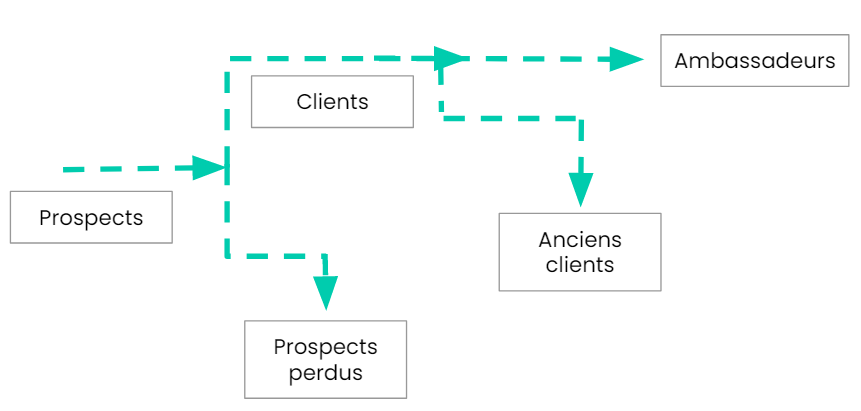
1) Audit your business ecosystem
We recommend that you carry out this analysis of your customer journey in two main stages. The first consists of auditing your sales operations and existing marketing activities. The second, which we will describe in the next section, is more people-oriented.
For this audit, it is essential to take a step back. You (or your service provider) must map out: the main customer entry points, prospecting methods, the distribution and importance of the various contact channels (web, telephone, email, etc.), the journey taken in your information system (from the initial request to the signing of the quote), request processing times, etc.
You must have comprehensive knowledge of the sales and marketing activities that are common in your industry. This will enable you to easily identify any obstacles to a smooth customer journey. In addition, you can begin to consider how to optimize the "paths" taken by your prospects to ensure maximum conversion.
2) Survey customers and, above all, lost prospects
 The most rewarding lessons you will learn from this exercise will undoubtedly come from the returns from your lost prospectsPrice is often considered the sole reason for commercial failure in the industry: "we were more expensive than our competitors." However, well Other factors may influence your prospect's choice. : poor customer service feedback, poorly executed POC, long response times, too few services associated with the product, etc.
The interviews you conduct with your prospects or lost customers are therefore a wealth of information that will enable you to optimize your overall sales strategy. We recommend that you entrust this task to an external service provider, or at least to someone who is not directly involved with customers, so that they feel free to speak openly.
Satisfied customers should not be left out of the equation! Understanding what leads them to sign new contracts can also help identify certain patterns. For example:
- 90% of our satisfied customers have subscribed to Service X, which prevents supply disruptions.
- The majority of our satisfied customers are mid-sized companies, and the production manager is our main point of contact.
- Most of our satisfied customers have been acquired in the last two years.
This highlights important information: perhaps you find it easier to collaborate with certain roles, or perhaps former customers have acquired bad habits that are now causing dissatisfaction. Once you have completed this work on your customer journey, you can briefly revisit your personas to flesh them out further and validate or invalidate certain assumptions.
3) Establish a list of recommendations that can be implemented quickly
The audit and interviews provide data of varying complexity, which must now be analyzed to create a list of recommendations relating to your offering, your distribution channel, your communication, etc. These lists are often long, so to ensure they remain effective, set priorities and deadlines (or require your service provider to do so). Some optimizations can certainly be implemented very quickly, without investment or major internal disruption.
Over the months, you will be able to tackle larger projects with greater ease, as the small "blocking" elements will already have been identified and corrected.