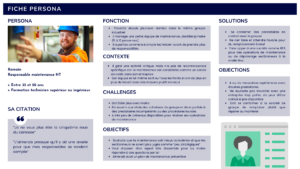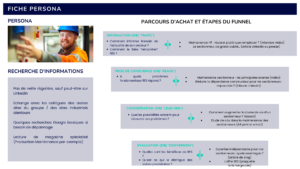


Does an imaginary character's ID card mean anything to you?
This is what is known as the persona. It is a very effective marketing method for putting yourself in your customers' shoes.
A brief overview of your typical prospect.
Personas for industry: what are they and why are they important?
Definition
More commonly referred to as the "ideal customer, " the persona is, in the context of a marketing strategy, an imaginary person imaginary and fictional person representing a group or segment of target customers.
Objective
The development of this type of profile should not be left to chance, and for good reason! This reflection will enable you to target the right prospects and best meet their needs/provide the best solution to their problems.
Still unsure about the usefulness of this typical portrait?
The persona creation stage is fundamental to your strategy, even in the industrial sector. It allows you to refine your customer search by identifying the best marketing and sales actions to be carried out by your marketing and sales teams with your target audience.
We have compiled a list (which is by no means exhaustive^^) of the benefits of having a good understanding of your persona(s), which should help you understand the impact this can have on your marketing strategy and, therefore, on your sales.
The persona in the industry should enable you to:
✅ Understand your target audience's purchasing journey so you can prospect the right customers at the right time.
✅ Understand the needs and challenges of your prospects in order to tailor your value proposition and evaluate your products and services.
✅ Work on your knowledge of your prospects' professional profiles (companies, positions, roles), so you can contact people who are more likely to be interested and increase the number of qualified leads.
✅ Offer interesting content based on your knowledge of prospects' interests, which you can distribute through the most relevant channels.
The specifics of personas in the industry
Finally, when building your persona, there is no need to refer to documents found on Google, which are more B2C-oriented. These are far too general and clearly lack detail.
In industry in particular, the details of personas must be more detailed. Criteria must be defined that are not found in other sectors, and even less so in B2C!
Let's discover together aa concrete and effective way to obtain useful personas that will help you sell more.
Define your industrial persona in 3 steps
1 – Distinguish between different target categories
Before you start creating your persona, you need to have a detailed understanding of your market, which will enable you to build on solid strategic foundations.
Don't forget! You don't address all customers in the same way, which is why it's essential to segment your database and tailor your sales pitch to your audience.
For example, when selling production machinery to different sectors (luxury and sports, for example), your customer will not have the same expectations, so you will need to adapt your sales pitch: for luxury goods, it is preferable to highlight the precision of the machines, while whereas whereas for mass-market sports products, it makes more sense to highlight the speed of execution of the machines!
This is where segmentation comes into play: to target your customers correctly, establish categories based on the activity and characteristics of your customers.
Here are some examples of questions to ask yourself for your segmentation:
👉 Which sectors do I sell to? Which do want to sell?
👉 Which ones are the most profitable today? And tomorrow?
👉 In these markets, what type of target companies should I approach? (SMEs, large groups?)
👉 Who are my business contacts in these companies? (sales representatives, buyers, or executives?)
👉 If there are several, who is the point of entry? The decision-maker? (the CEO, the sales manager ?))
2 – Learn more about your target audience's concerns during the purchasing process
This is probably what will take you the most time: trying to identify your target audience's concerns at each stage of the decision-making cycle. To help you understand, here is an example:
AWARENESS
- What issues does he face?
- What are his "pain points," his frustrations?
- How mature is he? Is he truly aware of the issues?
CONSIDERATION
- What options are available to solve this problem?
- What changes and adjustments do they entail?
- Has he already tried to implement these solutions?
CONVERSION
- What solution do we want to offer him?
- What are the intrinsic performance characteristics of the solution?
- What sets it apart from its competitors?
3 – Enrich the persona profile with their identity card
Humanize your persona by gathering basic information that describes your ideal, realistic customer based on their habits, aspirations, etc.
Some criteria to define:
💡Age and occupation
💡The geographic area
💡Areas of interest
💡Professional habits
💡Search queries in Google
💡Trade shows attended
These elements, which may seem trivial to you, are a gold mine when it comes to implementing the marketing action plan. marketing. They enable you to allocate budgets to the most effective channels and achieve maximum ROI!
An example of a persona in the industry