
Have you ever heard that communication is useless? You think ? Yet it is important to promote your business, isn't it?
Too many manufacturers still prefer staying in the shadows for fear of communicating poorly or because they think that exposing themselves could discredit them or put them at risk vis-à-vis the competition. But now more than ever, whether it's to survive in a highly competitive sector or to overcome recruitment issues, investing in a real communication strategy is essential.

In all professions, but especially in the technical and practical world of industry, some people are comfortable with technology but not with representation, and vice versa. And yes, you can't be good at everything, and thank goodness for that!
In this article, we explain why communication is important and why it is often necessary to entrust it to a professional (us, for example!).
Communication is an integral part of a company's activities.

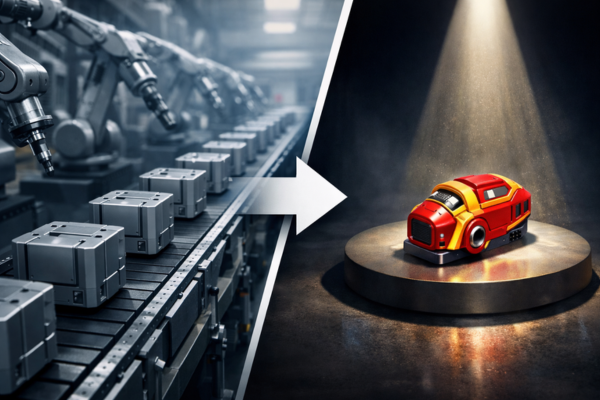
In any business that doesn't want to go bankrupt, communication is not an option. Let's use the metaphor of a movie theater to illustratethis point. Even if a masterpiece is showing, if you haven't seen the trailer, read a review, or seen a billboard— in short, if you don't know it exists— do you think you'll go see it? Unless you're a real movie buff who spontaneously checks your local movie listings every week, probably not!
The same goes for your business! the same for your business! Even if you produce a revolutionary product or offer a service that meets a real need, if no one knows about it or understands it, you won't get very far. It's as simple as that.
Communicating: skills that cannot be improvised
Industrial sector: communication difficulties
Most manufacturers are passionate and believe strongly in their business. That's a good start, but it's not enough. You need to be able to explain clearly and simply what you do, why you do it, and, above all, why it is useful to your customers. As a marketing agency, we often find ourselves talking to people who are unable to do this. Here are the main pitfalls you may encounter:
- Lack of conciseness: when you are proud of your business, you want to say a lot, sometimes too much, at the risk of obscuring the essentials.
- Lack of precision: Conversely, a customer needs to know enough to decide whether you are of interest to them.
- Lack of direction: presenting an idea in a straightforward manner without your brain wanting to digress every second is not that easy!
- Lack of prioritization: Everything you say is undoubtedly interesting, but what is most important? What is the priority?
And the list goes on. Do any of these points ring true for you? Don't worry. The good news is that communication isn't your job ( phew, we're saved! 😉). More seriously, as an industry professional, you are undoubtedly highly skilled in your field, and that's what matters most. Just as some people are skilled communicators!
Industrial communication: different stages to master
Contrary to what one might think if one is unfamiliar with the communications and marketing professions, talking about your business is not just a matter of writing a few sentences and creating pretty pictures. To produce relevant content that showcases your business, you need to follow and master various steps:
- Searching for additional information: When addressing technical topics, knowledge often comes from operational staff in the field. They pass on this knowledge, which is then formatted by an internal or external communications specialist. But sometimes, additional information is needed, particularly contextual details, which must be researched.
- Choosing an angle: once the raw material has been gathered, you have to decide what to do with it. What idea do you want to convey? To whom? What is the purpose of the content?
- Selecting information: to stay focused on the defined objective, you have to sort through the information, as not everything may be useful for the chosen angle.
- Simplifying technical information: the information collected is generally difficult to digest in its current form. It must be reworded, explained, or simplified to make it accessible and understandable to the target audience.
- Writing: the content is then written.
- Enrichment: to ensure high quality, content must be proofread and supplemented, preferably by another person who may have a different perspective and additional input.
- The correction: the content must be corrected. And that's no small task—you have no idea how many rules and exceptions there are in the French language that no one has ever heard of. So many pitfalls!
- Distribution: the content must then be allowed to reach its target audience by choosing the right channels, the right moments, and the right visuals, among other things.
Specific skills to make a real difference
These different stages in the content creation process clearly show that creating relevant, high-quality content cannot be improvised.
Your industrial company's communications deserve special attention, with a real program. To achieve this, once you have reached a certain size or level of maturity, you cannot afford to overlook working with a communications and marketing professional. Whether you hire someone in-house or collaborate with an agency, surround yourself with competent people. And while competence starts with appropriate training, the real added value in marketing and communications lies largely in experience and expertise.
For example, at MITI, as we are specialize in industry, we are used to working with engineers and technicians. We therefore acquire a a wealth of practical knowledge, but are also able to guide our clients to bring out knowledge and achieve the right level of simplification, find good anecdotes (read Pierre Ellow's testimonial, Pronomic). With technical profiles, it is necessary to be proactive and a driving force, because in most cases, they are spontaneously interested in representation exercises or not comfortable with communication in general.

As you can see, the art of effective communication cannot be improvised, especially in a field as technical as industry. Calling on specialized professionals allows you to benefit from a fresh and expert perspective on your business, ensuring the dissemination of high-quality messages tailored to your target audience. This is what will make all the difference between two similar companies. You don't want your business to flop like an arthouse film, do you?
Want to make us your superheroes? Contact us!